When you pay for IT support, what are you actually getting? A service level agreement puts all expectations in writing, from response times and availability to communication, escalation, and the level of support your business can rely on.
What is a Service Level Agreement?
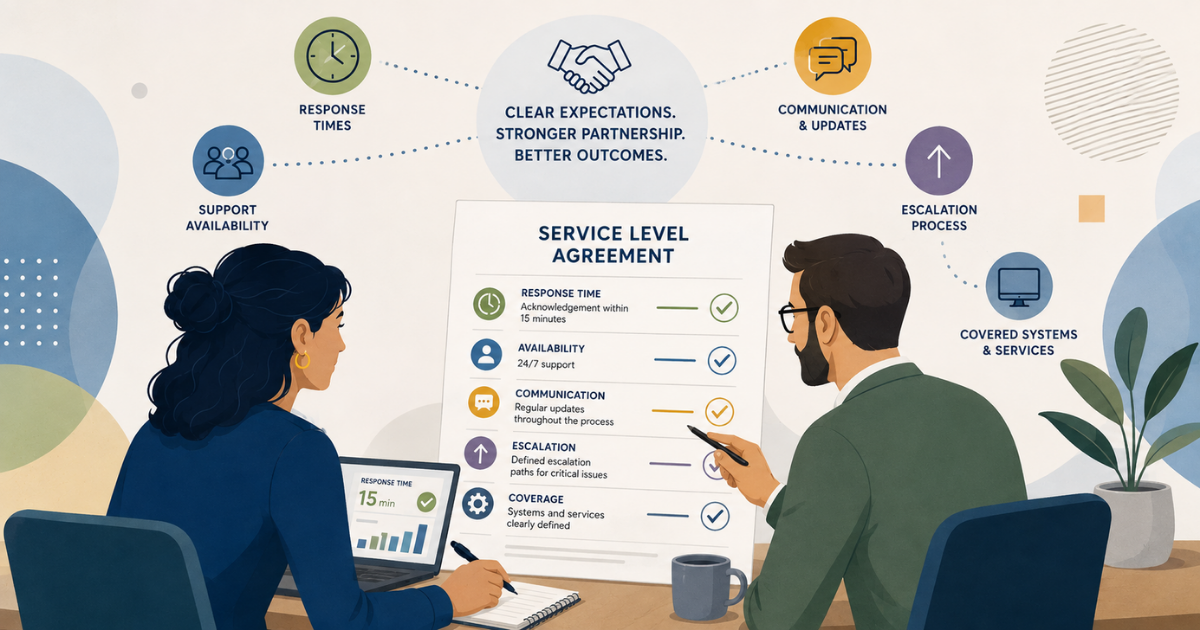
A service level agreement (SLA) defines the level of service and support a business can expect from its provider. A well-defined SLA establishes expectations for response times, escalation paths, communication procedures, and support availability before an incident occurs.
Rather than creating uncertainty during a disruption, everyone involved understands what level of support is being provided and how the issue will be managed. Businesses should understand the answers to a few key questions about their agreement:
- Is support provided during business hours only, or after hours as well?
- Are critical incidents escalated differently than routine requests?
- How quickly can a support team realistically respond?
- What communication can stakeholders expect during an outage?
- What systems or services are covered under the agreement?
The goal is not simply to have support available in case of an incident. The goal is to ensure the level of support aligns with the operational risk of the business. However, an SLA is only valuable if the level of service it defines matches your organization's needs.
Not Every Support Plan Includes the Same Level of Response
One of the biggest misconceptions businesses have about support is assuming that every service provider responds to critical issues the same way. In reality, support models vary significantly. Some providers offer best-effort support, where requests are handled as resources become available. Others provide defined service levels with documented response targets, escalation procedures, and after-hours coverage.
The difference becomes most apparent during a business-critical outage. If a customer portal becomes unavailable during normal business hours, a response within a few hours may be acceptable. If the same outage occurs overnight, on a weekend, or during a critical business event, the expectations are often very different, which is where your SLA becomes especially important.
Why Response Time Isn't Enough
Many organizations evaluate support providers based on response times. Response times are important, but they only measure how quickly someone acknowledges a problem—not how effectively the problem is managed. Imagine two different scenarios:
Scenario A
- Ticket acknowledged in 10 minutes
- No clear escalation path
- Limited communication
- Multiple handoffs between teams
- Service restored in 8 hours
Scenario B
- Ticket acknowledged in 20 minutes
- Incident immediately escalated
- Stakeholders receive regular updates
- Technical resources are engaged quickly
- Service restored in 2 hours
Which experience would you prefer?
The difference isn't the response time. It's the process behind the response.
How Gate 39’s Managed Services Can Support Your Organization
At Gate 39, we believe effective support is about more than responding to tickets. Our managed services approach combines service level agreements, incident management processes, infrastructure & application support, and disaster recovery planning to help organizations reduce operational risk and maintain business continuity.
If you're evaluating your current support model, Gate 39 can help you assess whether your service levels, escalation procedures, and support coverage align with your needs. We act as an extension of your team, providing experienced infrastructure, application, and managed services support without the overhead of expanding your in-house staff.
You might also be interested in:





.svg) Contact Us
Contact Us
.jpg)