


Secure Data Sharing: How to Prevent PII Leaks in Client Communications
Data sharing isn't just a daily task—it’s a constant in client relations. Whether you’re fulfilling a request or receiving sensitive files, the exchange of information is unavoidable. However, with this convenience comes a massive responsibility: security.
No one intends to leak Personally Identifiable Information (PII), but a simple "reply" can lead to a major breach.
Data sharing is inevitable; data exposure shouldn't be. When interacting with clients, the exchange of reports and files is a daily occurrence. But without the right "best practices," you are one click away from a PII leak. The danger often hides in the most common workflows.
Global Statistics on Data Sharing Risks
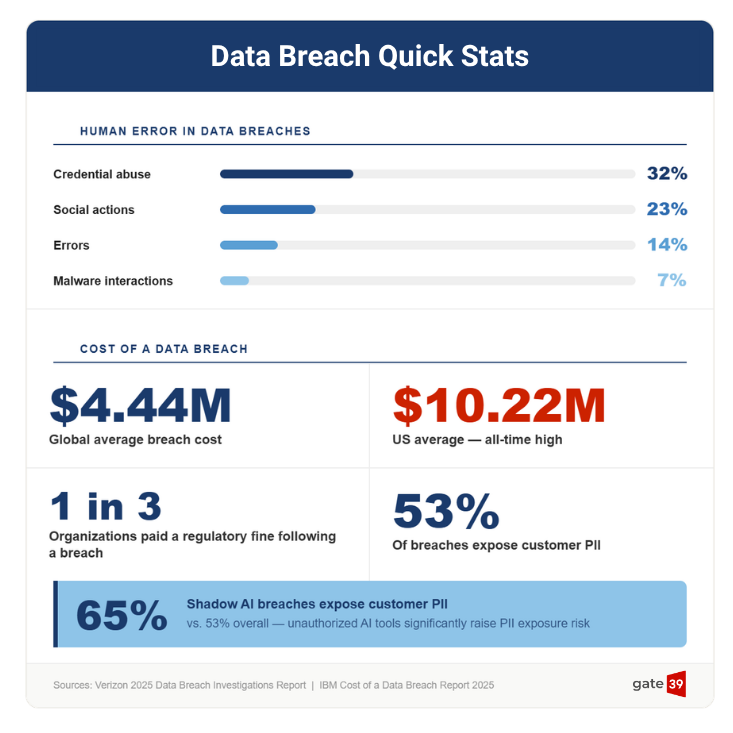
The "human element" remains a primary contributor to data breaches—a consistent finding in leading cybersecurity reports for 2025 and 2026, such as the Verizon 2025 Data Breach Investigations Report and IBM’s Cost of a Data Breach.The report by Verizon highlights that approximately 60% of all data breaches involve human error of some kind.
The Verizon report identifies these key, high-level components of the human element:
- Credential Abuse (32%): The most prevalent human element component and remains a major concern.
- Social Actions (23%): Includes techniques like phishing and pretexting.
- Errors (14%): Unintentional mistakes made by internal actors, such as misdelivery of information.
- Malware Interactions (7%): Clicking on malicious email attachments.
According to the IBM report, shadow AI is unsanctioned AI use or unauthorized AI tools. In these breaches, the percentage of compromised customer PII is significantly higher, reaching 65%.
Actionable Recommendations
Daily Security Guidelines For Staff & Support Personnel
For the frontline team, the goal is to eliminate "accidental" exposure through better daily habits:
- Stop the "Public Link" Habit: Never use "Anyone with the link" settings. Use identity-based sharing where the recipient must log in to view the file.
- The "Double-Check" Rule: Before hitting send on an attachment, ask: "Does this report contain PII?" and "Does this specific user need to see it?"
- Use Data Masking: If a client needs an analytics report to "see the trend," mask the sensitive columns (like email addresses or phone numbers) before exporting the PDF.
Business-Level Operational Recommendations
Company systems should be designed to catch human error before it becomes a breach:
- Identity is the New Perimeter: Move away from protecting "the network" and start protecting "the identity." Implement Multi-Factor Authentication (MFA) and Role-Based Access Control (RBAC) so that only the assigned Support Engineer can see a specific client's data.
- Automate Data Retention: Set "expiration dates" on shared links.
- Shadow AI Governance: Employees often use AI tools to "clean up" data. Ensure your team isn't pasting client PII into public AI bots to generate summaries or charts.
Strategic Guidance for Business Leaders
For leaders, security is a competitive advantage, not just a compliance checkbox:
- Adopt "Privacy by Design": When building new support workflows, ask: "How can we fulfill this request with the least amount of data shared?"
- Shift from "Compliance" to "Trust": Be transparent with your clietns around your privacy policies to give them the peace of mind they deserve.
- Invest in Continuous Training: Use simulated phishing and "near-miss" reporting to keep the team sharp. Reward employees who catch and report potential PII exposures.
Shared Responsibility for Data Security
In the world of client support, it is easy to prioritize "speed of resolution" over "security of data." But as we’ve seen, a single public link or an unvetted attachment can turn a helpful gesture into a costly compliance breach.
Protecting PII isn't just about following legal checklists like GDPR; it’s about maintaining the hard-earned trust of your customers. Whether you are a Support Engineer sending a daily report or a Business Leader setting company-wide policy, the goal remains the same: Share with intent, not by accident.
By moving away from "public" sharing habits and embracing secure, identity-based portals, we can ensure that our data—and our clients' privacy—remains exactly where it belongs: in the right hands.
Quick Security Checklist
Before you hit "Send" on your next client interaction, ask yourself these three questions:
- Is this link private? (Does it require the recipient to log in?)
- Is this data necessary? (Can I redact the PII before sharing the report?)
- Who else can see this? (Is this attachment visible to everyone in the ticketing system?)
At Gate 39, security is an intrinsic part of our managed services. We design and manage environments specifically for regulated financial and agricultural firms, which means structured access control, hardened systems, monitored backups, and compliance-aware documentation.
If you want to evaluate how your hosting environment supports security and compliance, contact us to start a conversation.
You might also be interested in:
Agriculture is technically a B2B industry, but marketing to an ag audience rarely feels like traditional B2B marketing.



Connect with us to discover how we can help your business grow.
.svg) Contact Us
Contact Us
.jpg)