If you’ve used ChatGPT or another AI tool recently, you already know it can be impressive. Type something in, get something back, move on with your day. Most people stop there.
That’s also why most companies are barely getting any real value from AI.
The businesses seeing actual results are not just asking AI questions. They are putting it to work. They use it to handle repetitive tasks, follow internal standards, organize information, and support workflows in the background while their teams focus on higher-value work. The difference is not the tool itself. It is how the tool is being used.
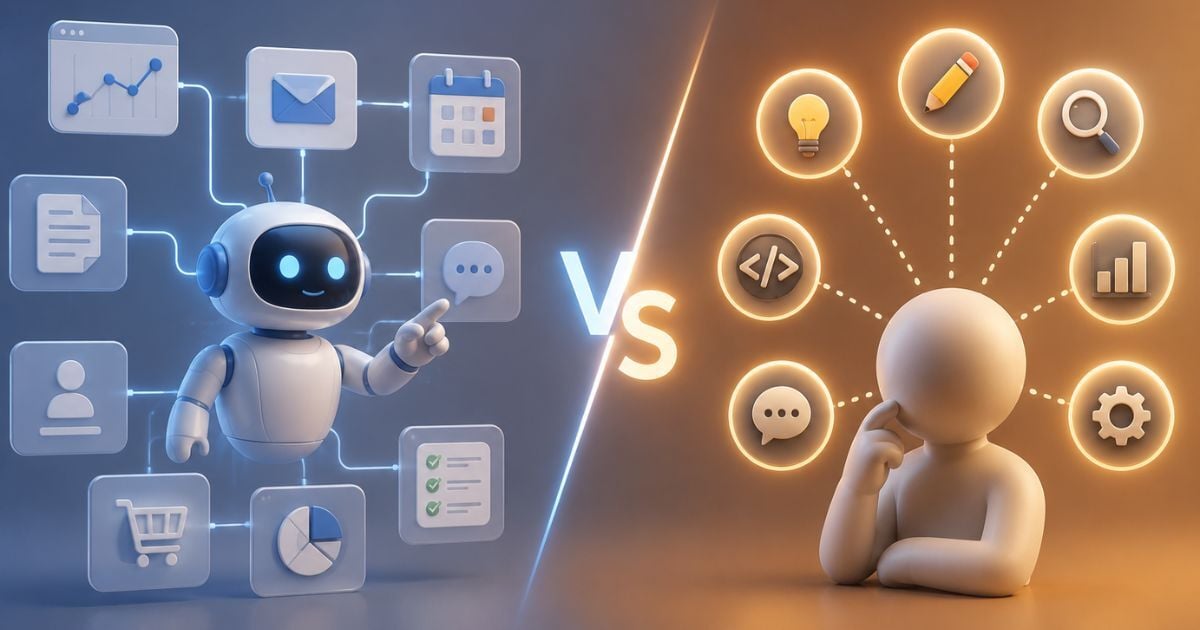
To understand that shift, you only need to understand two concepts: agents and skills.
What Is an AI Agent?
An AI agent is designed to complete a task without needing constant supervision. Think of it like hiring a contractor. You explain the goal, define what success looks like, and let them handle the execution. You are not standing over their shoulder explaining every step along the way. Humans already hate micromanagers. Apparently AI does too. Strange little moment of solidarity there.
There are two kinds of agents to know about:
Interactive Agents
Interactive agents allow you to check in while they are working and provide feedback during the process.
This is the equivalent of calling the contractor halfway through the job and saying, “Actually, let’s change this part before you continue.”
Background Agents
Background agents work independently from start to finish. You hand off the task, they complete it, and the finished output is waiting for you when it’s done. Think overnight processing, automated reporting, or recurring operational work that nobody on your team should still be assembling manually in 2026.
For example, instead of someone spending Monday morning pulling together a weekly performance summary, an agent can gather the data, organize it, identify unusual trends, and prepare a polished report before the team meeting even starts. Your team’s job becomes reviewing and making decisions, not wasting time building the document itself. That distinction matters more than people realize.
What Is an AI Skill?
A skill is a saved set of instructions that teaches AI how to complete a task your way, every time.
The simplest analogy is a recipe. A talented chef can cook almost anything. But if you want your grandmother’s exact pot roast recipe, you hand the chef the recipe card. The recipe card is the skill.
Businesses already create systems, templates, guidelines, and standards because consistency matters. Skills do the same thing for AI. Without a skill, AI gives you something generic. Usually decent. Occasionally weird. Sometimes suspiciously confident while being completely wrong. A very human quality, honestly.
With a skill, the AI follows your formatting, your tone, your processes, and your expectations so the output actually feels like it came from your team instead of sounding like a motivational LinkedIn post written at 2 a.m.
When to Use Each and How They Work Together
You do not need to choose one or the other. But it helps to know what each one is good for.
Situation
|
Use an Agent
|
Use a Skill
|
| Task is time-consuming and repeatable |
✓ |
|
| You want it to run on a schedule without your involvement |
✓ |
|
| You need a fresh perspective with no prior context |
✓ |
|
| You have a process you would explain the same way every time |
|
✓ |
| You want consistent tone, formatting, or standards in the output |
|
✓ |
| You need to check in and give feedback while the work is happening |
|
✓ |
| You want AI to handle a full workflow from start to finish |
✓ |
✓ |
That last scenario is where things start getting interesting.
Imagine your firm sends a client-ready market summary every Monday morning. An agent can automatically gather the latest information, organize the content, and generate the draft. A skill then tells the AI how your firm structures the report, which metrics matter most to your clients, and what tone the final output should have. The result is something that feels polished and intentional without requiring someone on your team to spend half their morning assembling it manually.
The easiest way to think about it is this: Agents do the work. Skills teach them how your business works.
What This Means for You
AI is no longer just a writing assistant or novelty tool. It is quickly becoming part of how businesses operate. The companies getting the most value from AI are not necessarily the ones using the most advanced tools. They are the ones thoughtfully deciding:
- Which tasks should be automated
- Which processes should be standardized
- Which workflows are wasting time today
- Where human attention is actually most valuable
That is where the real return comes from. Not from generating funny images or asking ChatGPT to write another email nobody wanted to receive in the first place. Humanity truly saw near-infinite computational intelligence and immediately asked it to draft follow-up emails. Extraordinary species.
At Gate 39, we use these tools in our own workflows every day. They influence how we build solutions, how we deliver work, and how we think about technology overall. That perspective shapes the way we approach client engagements because successful AI adoption is not about chasing trends. It is about building systems that genuinely help people work smarter.
Curious Where AI Fits Into Your Business?
You do not need to have everything figured out before starting the conversation. If you are exploring what AI could realistically do for your business, not just in theory but in practical day-to-day operations, we would be happy to talk through it with you.
You might also be interested in:





.svg) Contact Us
Contact Us
.jpg)