A few weeks ago, we were minutes away from launching a client's new website. The migration had gone exactly as planned: files copied, database synced, testing passed. Everything looked ready. The last step was updating the DNS. Simple enough.
Except the Cloudflare account we'd been pointed to didn't actually manage the domain. After a bit of digging, we discovered the domain was still sitting in a Cloudflare account created years earlier by a previous developer. That account wasn't just handling the website. It was also managing email routing and several other DNS records that nobody realized were still in use.
Technically, we could have moved the domain. It would have taken about five minutes. But without knowing what else depended on those records, that wasn't a risk worth taking.
So we stopped. Instead of rushing the migration, we tracked down the correct Cloudflare account, mapped out everything that depended on those DNS records, and only then completed the migration.
From the client's perspective, it probably looked like the project had stalled over "just DNS." From our perspective, we had just avoided creating a much bigger problem.
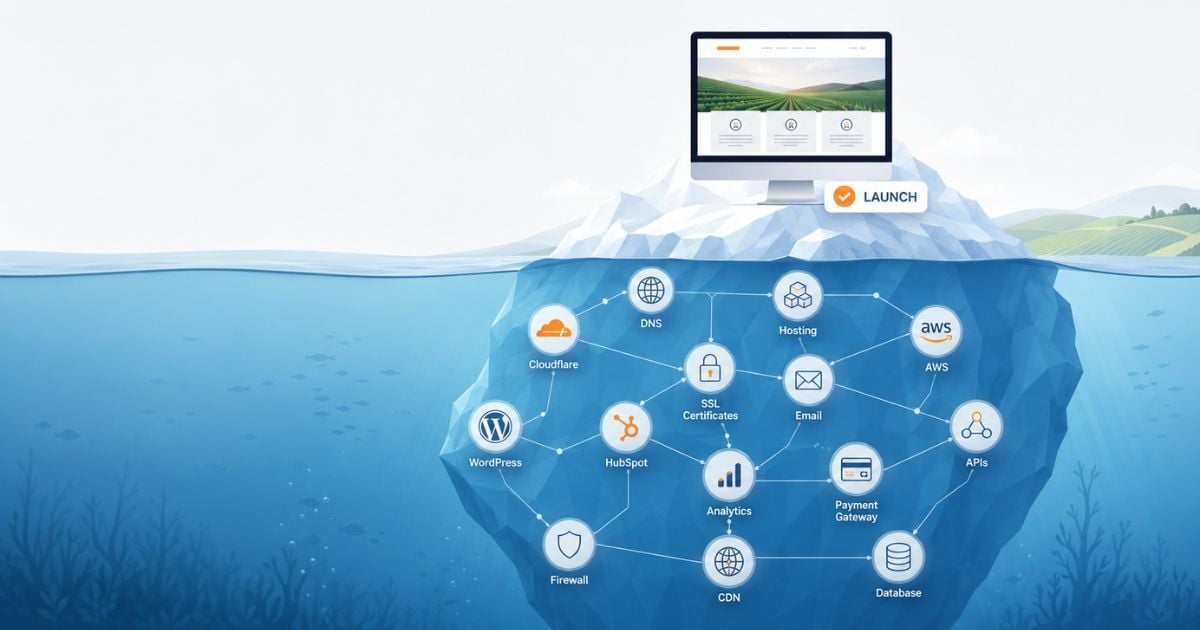
That experience reminded me of something we've learned after years of building, hosting, and supporting websites: Website projects rarely get delayed because writing code is hard. They get delayed because modern websites are really a dozen systems wearing one URL.
Everyone Is Solving a Different Problem
People often assume a website migration is simply moving files from one server to another. In reality, today's websites are connected to an entire ecosystem:
- DNS
- Cloudflare
- Hosting
- AWS
- SSL certificates
- Payment gateways
- WordPress
- Third-party APIs
- HubSpot
- Analytics
- Email services
- Firewalls
Changing one piece often means touching several others. That's where communication becomes just as important as technical expertise. Our engineers are usually focused on delivering the project. Internal IT teams are focused on protecting business systems. Hosting providers are responsible for infrastructure. Marketing teams want to launch campaigns.
Everyone is doing their job. The challenge is that everyone is optimizing for something different.
The Vendor Ping-Pong Match
One of the most common conversations we see goes something like this:
Hosting Provider: "You'll need to talk to IT."
IT: "The domain registrar manages that."
Registrar: "Cloudflare controls the DNS."
Cloudflare: "Those records already existed."
Previous Developer: ...hasn't worked here in four years.
Meanwhile, the client is wondering why launching a website suddenly feels like an archaeological expedition through infrastructure that was built six years ago by someone who no longer works there.
Every answer is technically correct, but nobody is answering the actual question: Who owns the entire system?
Sometimes the Root Cause Is Somewhere Else Entirely
Not every issue is where it first appears. Recently, we worked on another website that started experiencing intermittent timeouts after a server migration. At first, everything pointed toward hosting. Server resources looked healthy. The migration had completed successfully.
After tracing requests through the system, we discovered the real issue wasn't the server at all. Unrelated to anything in the migration itself, a plugin was stuck in a loop, repeatedly trying to update its database and quietly eating up server resources with every failed attempt.
Adding more CPU or memory wouldn't have solved anything. The fix was understanding how every part of the system interacted.
Finding the real root cause often means looking beyond the obvious.
Where We Take a Different Approach
One thing we've learned over the years is that clients shouldn't have to become project managers for their own vendors. If your agency says one thing, your hosting provider says another, and IT is waiting on someone else, progress slows to a crawl. When we manage both your website and your hosting, many of those conversations happen internally.
The engineers building your website are the same engineers managing the infrastructure behind it.
-
If we need to investigate performance, we already have access.
-
If we need to update server configuration, we don't have to wait on another vendor.
-
If we need to troubleshoot DNS, SSL certificates, caching, APIs, or integrations, we're already looking at the entire picture instead of just one piece of it.
That doesn't mean every change happens instantly. Some requests still depend on third-party providers, domain registrars, DNS propagation, or external services. But removing unnecessary handoffs dramatically reduces the amount of time spent waiting for someone else. Instead of spending days figuring out who owns the problem, we spend our time solving it.
Good infrastructure isn't just faster servers. It's fewer people standing between you and a solution.
The Best Launches Feel Boring
Ironically, the smoothest website launches are usually the least memorable.
-
Nobody notices that email kept working.
-
Nobody notices that DNS propagated without issue.
-
Nobody notices that the payment gateway never skipped a beat.
-
Nobody notices that the launch happened exactly when it was supposed to.
That's exactly how it should be. The best engineering isn't the code nobody notices. It's the complexity nobody ever has to think about. When everyone understands the system and someone takes ownership of the entire picture, website launches stop feeling like emergency response exercises and start feeling routine.
And honestly, that's our goal. If we've done our job well, the only thing our clients notice is that their website works.
That's Where We Come In
Our job isn't just building websites. It's helping clients navigate the technology behind them, coordinating infrastructure, working alongside internal IT teams, and solving problems before they become roadblocks.
If that sounds like the kind of partner you're looking for, we'd love to talk about your next project. Reach out to us today to start the conversation.
You might also be interested in:






.svg) Contact Us
Contact Us
.jpg)